


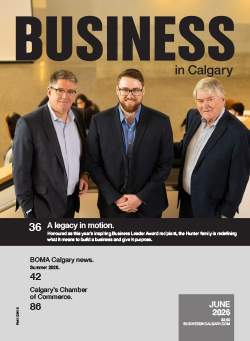
There’s a moment, tucked into a conversation about recognition, where the story begins to carry its own weight.
A story of modest beginnings, bold choices and generational growth.
From early ventures in the oilpatch and early-stage tech to public service and community leadership, the Hunter family’s story will be formally recognized this month by the Haskayne School of Business at the University of Calgary and the Calgary Chamber of Commerce as recipient of the 2026 Inspiring Business Leader Award.
“It’s a recognition of what we’ve accomplished so far – and there’s more to come,” says Doug Hunter, the family patriarch and co-recipient of this year’s award alongside his son Derrick and grandson Adam.
To understand more, you have to go back to where it started.
Doug didn’t set out to become an entrepreneur. In fact, when he graduated from the California Institute of Technology with a master’s degree in 1965, he hadn’t even heard the term.
“I thought I’d just go get a job and work my way up,” he says.
Instead, he did something different. In 1972, he, along with a geologist partner, promoted the drilling of the first commercial shallow gas well in northwest Alberta in the Bluesky-Gething formation. This led to plans to launch a junior oil and gas company in 1974. Importantly, it would also define everything that followed – not just in terms of business success, but in shaping a mindset that would ripple through generations to come.
That mindset was tested early. Doug had plans to launch an oil and gas company with $5 million in financing. Yet that funding evaporated when the first OPEC crisis hit. What remained was a far more modest starting point of $283,000, raised through personal networks.
It wasn’t much, but it was enough.
The company that emerged was Bluesky Oil & Gas, named after Doug’s first well in the Bluesky formation in northern Alberta and B.C. Built on conviction, it signaled a pattern that would repeat itself over decades in which Doug would identify an opportunity, take a calculated risk and build from there.
Yet it wasn’t just Doug who was setting the stage for what would become for the Hunter family. If Doug’s early career was defined by entrepreneurial risk, his wife Diane’s was defined by public impact.
Diane was an alderman with the City of Calgary from 1983-89, serving on key committees spanning finance, land use and economic development. She became the first woman appointed to the Calgary Police Commission, eventually serving as vice chair. She also held leadership roles with the Calgary Airport Authority, University of Calgary Board of Governors and Senate and numerous provincial and national initiatives.
Her work extended into education, mental health and economic policy, including leadership roles with the Canadian Mental Health Association and Alberta Economic Development Authority.
Together, Doug and Diane created an environment that would shape the family’s creed.
“My dad and mom were very entrepreneurial,” says Derrick. “We grew up with this idea that the only security you have in this world is what you can do and what you bring to the table.
“If we had an idea, we were encouraged to just go for it.”
By the time Derrick joined his father at Bluesky Equities Ltd. in 2007, the company was still rooted in oil and gas. Yet the industry, and broader economic landscape, was changing.
Recognizing the need to diversify, the family made a move that, at the time, was far from obvious. They entered the U.S. multifamily housing market, establishing a position during the 2008 financial crisis.
The bet paid off. Over five years, Bluesky and its partners amassed a portfolio of several thousand apartments across 10 states, reinvesting equity from rising property values into successive acquisitions.
Eventually, the company exited real estate and evolved again. Today, Bluesky Equities is a privately held investment firm with a broad mandate – spanning global equities, fixed income, credit strategies, venture capital, real estate and energy. It operates with a small, focused team, but a wide lens.
Derrick describes Bluesky as less of a traditional investment firm, and more akin to an all-weather fund structured to generate consistent returns while managing risk across generations.
“My goal for years has been to produce positive returns every year and to minimize drawdowns,” he says. “I’m responsible for navigating this organization for the benefit of my family – all down the line.”
That long-term view shapes everything for Bluesky, from portfolio construction to how opportunities are evaluated. It’s also what led the company into the innovation ecosystem.
Since 2012, the firm has invested in more than 100 seed-stage companies, earning recognition as both National Angel Investor of the Year and Alberta Tech Investor of the Year in 2019.
But even there, Derrick is quick to qualify they are not investing in sectors but, rather, people.
“We invest in founders,” he says. “A lot of them happen to be early-stage technology founders because that’s where you get bang for your buck.”
It’s a philosophy grounded in something the Hunters talk about often: entrepreneurial thinking.
For Doug, entrepreneurial thinking is universal.
“It can be applied just about anywhere,” he says. “Even in government organizations if they have the right culture.”
For Derrick, it’s more specific.
“It’s about training people to spot opportunities when they present themselves, and then having the confidence and conviction to act,” he says.
That distinction – between recognizing opportunity and acting on it – is what led the family to philanthropy, one of their most significant areas of impact.
Doug and Diane founded the Hunter Family Foundation in December 1984. Over time, it grew both in size and ambition.
An inflection point came in 2000 when Doug and Diane committed to giving away half their assets – a decision that pre-dated similar pledges from those such as Warren Buffett and Bill Gates by more than a decade.
Years later, the family accelerated that commitment by making a deliberate choice to scale up giving during their lifetimes and, in turn, allow multiple generations to be involved in the process.
The foundation would focus on three core areas: entrepreneurial thinking, classical liberalism and mental wellness. Within those areas, the goal wasn’t just to fund isolated initiatives, but to make what the family calls “big bets.”
“We spent a lot of time debating and discussing our values – discussing areas where we wanted to make a systemic change. Once we did that, we said that we didn’t just want to give money to solve a problem today, only to have it return tomorrow. We wanted to teach a man to fish, not to give a man a fish.”
That philosophy has since guided a series of transformative contributions, notably at the University of Calgary.
Through a 2012 gift from the foundation, the family helped establish what is now the Centre for Entrepreneurship and Innovation at the Haskayne School of Business. The family’s work expanded in 2017 with the creation of the Hunter Hub for Entrepreneurial Thinking, a cross-campus initiative designed to connect ideas, disciplines and people.
The Hunter family’s relationship with the post-secondary began with a simple idea: if entrepreneurship drives economic opportunity, then universities have a critical role to play.
“It’s about creating the conditions where people – students, faculty, researchers – can recognize the opportunity in what they’ve built and feel equipped to act on it,” says Derrick, who, with Diane, are alumni of the university. Doug and Diane have also received honorary doctorates.
The ripple effects are intentional.
“If you can do that well, it doesn’t just benefit the university. It starts to shape the economic trajectory of an entire city,” says Derrick.
The belief that a stronger entrepreneurial ecosystem leads to a more resilient economy has informed the foundation’s broader work, which includes mentoring and advising through several university initiatives such as the Haskayne School of Business Management Advisory Council; UCeed, an early-stage investment fund for startup companies; and The Real Deal, an experiential learning program.
Derrick is also one of 16 fellows with Creative Destruction Lab – Rockies, where he actively mentors early-stage science and technology startups.
Beyond entrepreneurship, the family has championed initiatives aimed at strengthening mental health systems. Among them is the Converge Mental Health Coalition, a national initiative that brings leaders together to advance mental health system transformation in Canada.
The family also backed the creation of The Hub, a digitally native news organization grounded in the principles of classical liberalism such as free speech, property rights and the rule of law. Through The Hub, the family sponsors the annual Hunter Prize, which challenges entrants to provide solutions to “wicked problems” confronting Canada.
Adam Hunter grew up inside this framework. At 14, he started participating in family meetings – an annual gathering where everything is shared openly, from investment strategies to philanthropic priorities. It’s part of a broader family constitution designed to ensure continuity across generations.
For Adam, that early exposure was formative.
“It was a gamechanger,” he says. “You learned about the opportunities you have in front of you.”
Today, Adam serves as a trustee of the foundation and co-manages its endowment as an associate at Bluesky. He brings a perspective shaped by a different set of economic realities that include rising inflation, housing affordability and shifting labour markets.
“I see what we do in the foundation as being related to that,” says Adam, who spent several years working in private banking before joining the firm. “We need free markets and entrepreneurship and supports for social health and wellness to actually address these problems.”
He is also clear-eyed about his role.
“I’m not an entrepreneur in the traditional sense, but entrepreneurial thinking – actively looking to solve problems, creating systems change – that’s something we’re always trying to do.”
There’s also a sense of responsibility: “I feel a sense of duty to be here – not just to our family, but to Calgary and Alberta as a whole.”
The word “legacy” comes up often in conversations with the Hunters. Yet it’s not used lightly.
“There are two ways of interpreting that word,” says Derrick. “One is as a legacy company. The other is our impact in the broader community.”
He notes that Bluesky is designed to endure through a structure built to support future generations of Hunters. The foundation, by contrast, has a defined lifespan. It is set to wind down 40 years after Doug and Diane’s passing, a deliberate decision to prevent mission drift.
That tension between permanence and intentional closure reflects a deeper philosophy: that legacy is not just about what you build, but how you steward it.
It’s also about adaptability. Derrick often references a lesson he learned that every generation in a family business needs an entrepreneur.
“What you start with may not be what it becomes. Things change. What got you to this point may not get you to the next point. Someone’s got to be aware of that, which is entrepreneurial thinking.”
For all the scale of their business and philanthropic work, the family remains understated about their recent recognition.
“I never really thought of us as inspiring. We just do what we believe we need to do,” says Derrick.
Adam sees it differently.
“From my perspective, you both really are inspiring,” he tells his father and grandfather. Donating half your wealth to the foundation before anyone else was doing that – that’s inspiring. Building a legacy company over time – that inspires me.”
It’s a rare moment of reflection in a conversation otherwise focused on forward motion. Because for the Hunters, the story is about what comes next.
As Doug puts it simply, “There’s more to come.”