


The current global population is just over eight billion, increasing at rate of about 0.85% per year (roughly 70 million added annually). This growing number of humans requires a growing number of things, food chief among them. Tasked with producing this food are many industries – agriculture, meat and dairy manufacturing and processing, grain and oilseed milling – whose technological advancements and international reach ensure the global food supply remains stocked.
Worldwide, the business of producing, processing, packaging, selling, preparing and selling food and beverages is valued at approximately $9.6 trillion and growing. And in a globalized world, no country is an island. Whether importing or exporting, all countries are subject to global trends, prices and geopolitical realities.
So when it comes to sulphur, now is a good time to be a Canadian processor and exporter.
Recognized as the fourth major plant nutrient after nitrogen, phosphorus and potassium, sulphur plays a vital role in farming: protein synthesis, amino acid formation, chlorophyll development, oil formation, nitrogen-use efficiency and overall crop quality.
As sulphur deficiencies become increasingly common given intensively cultivated soils and sulphur emissions reductions, sulphur nutrition is increasingly essential for sustaining agricultural productivity. Add to this geopolitical factors – the war in Iran and China’s moves to scale-down sulphur exports – and Calgary’s Sultech Global finds itself in an excellent position.
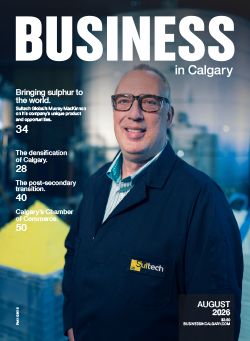
“We are doing great!” confirms Murray MacKinnon, founder and CEO. “We’ve got more orders than we can make. With everything going on in the world right now, sulphur has taken front stage. We’re in the right place at the right time.”
Sultech’s business is genius: take a traditionally low-cost, abundant byproduct of energy processing and use a patented, low-carbon intensive process to turn that byproduct into something the world wants and needs for various purposes.
“We take molten sulphur from sour gas plants around the Crossfield area,” MacKinnon explains. “We filter the sulphur and then pressurize it up. Then we inject it through our patented nozzles into our water polymer solution. From there it’s a wet slurry and we use gravity to move it between different high-energy screeners for different customer uses. Then one pump feeds it into our IP protected centrifuge. It’s an elegantly simple process.”
The micronized sulphur product – ultra-fine particles typically under 30 microns – can be maintained as a stable liquid suspension or de-watered into a powder, enabling multiple product formats and application methods. “Our products average 10 per cent surface moisture,” MacKinnon says. “It controls dusting. It’s safe to handle and transport.”
“And compared to larger sulphur products, we’re able to oxidize much faster,” he continues. “The bacteria oxidizes it over the entire growth period that the plant needs it. So when the plant is forming yield and really needs it, it’s still there. Whereas synthetic sulphate fertilizers can leach away.”
For example, MacKinnon notes, Sultech’s products match the performance of ammonia sulphate (AMS), the incumbent, in a normal year, and outperform it in a dry or wet year. On top of that, the carbon footprint to produce Sultech’s products is a fraction of that of AMS. “Because of our low-energy exothermic process,” he says.
The grandson of farmers in southern Saskatchewan, MacKinnon moved to Alberta as child because his father was in the oil industry. Summers were spent working on the family farm and his roots remain deep today; his cousins and nephews now run the family homestead.
“But I was going to be an oil and gas guy,” he reflects.
A graduate of SAIT in Mechanical Engineering Technology, MacKinnon began his career in Alberta’s energy sector, managing and delivering complex, multimillion-dollar projects that combined engineering innovation and practical execution. “I was lucky enough to do a lot of commercialization work, and got my name as a co-inventor on a few patents in my oil and gas days.”
He owned Wermac Electric for years with his brother and father: “We were innovators in the oil and gas industry.”
Given his background, he was approached to help commercialize a sulphur product.
“The technology was originally incubated at the old Alberta Research Council,” he says. “More for oil and gas. But it didn’t go in the direction they wanted and the project stalled. So it sat there for 14 years. In the meantime, there was a lot of research being done on micronized sulphur. So when we first started, our goal was just to make a better elemental sulphur fertilizer.”
Typical Alberta crops like canola, lentils, peas and legumes, which contain an oil or a high brix or protein content, benefit greatly from sulphur. “We really needed sulphur for these key Alberta crops,” he says. “And at that point, we’d cleaned up emissions so there was less sulphur in the air.”
MacKinnon took what was left of the original lab equipment and went to work putting it back together: “Then we kept developing the process to get the size and product we wanted. We started testing how we compared with other elemental sulphur products. We realized we really had something.”
At this point, a three-year study was commissioned on the basis of getting a peer-reviewed paper in the Canadian Journal of Soil Science. It showed that Sultech’s elemental sulphur outperforms synthetic sulphate fertilizers.
“That really lit a fire under us, and we decided we needed to commercialize and scale up,” he says. “Because that’s your biggest trick. It’s great to do it in a lab, but as you commercialize, sometimes things fall apart.”
In 2019, Sultech’s commercial demonstration plant was built in Crossfield, and the first production of totes occurred.
Being a commercial demonstration plant has put constraints on going to scale, though Sultech has been able to show it can access global markets. “The goal of the plant was to produce those volumes for research and testing and samples,” he says. “But now as demand’s much higher, we actually have to decide who to sell to. Because we only have so much at this point.”
Sultech sells to local grower groups too. “Our model is B2B,” MacKinnon notes. “And about 60 per cent of what we produce goes into other people’s products.”
Sultech is currently co-developing a number of products with other companies including in Ontario, Australia, Brazil and Japan.
About 20 per cent of Sultech’s products go into soil amendments, and the remainder goes down as a plant nutrient, particularly on canola, peas, chickpeas, potatoes and blueberries. “With regard to potatoes, we increase the table [higher grade] potatoes versus the lower grade processed potatoes,” MacKinnon notes, “and farmers get more for that higher grade potato. That’s how they increase their ROI.”
Sultech’s Australian business includes mixing its sulphur slurry with a gypsum slurry and as a fertilizer for cotton, which, with all the characteristics of an oil seed plant, benefits greatly from sulphur and is a huge value-add market in Australia. “We’re very excited to launch in September into the cotton industry there,” MacKinnon says.
Japanese interest in Sultech’s products relates to the strawberry market, and how sulphur makes the fruit sweeter. “The Japanese are very excited about that,” MacKinnon smiles. “They’re also very interested in if we can increase the sugar content in onions and leeks. If Japan accepts your product and sees value in it, that accelerates other markets.”
Last year, MacKinnon travelled to Abu Dhabi to sign an MOU agreement with ADNOC Sour Gas to establish the UAE’s first commercial micronized sulphur manufacturing facility. “They’re increasing their sulphur production in the UAE with all the LNG and ammonia projects,” he explains.
Beyond agriculture, Sultech’s products are now being incorporated into rubber matting products manufactured in Quebec. After its Chinese supply ended, the Quebec company contacted MacKinnon asking if Sultech’s micronized sulphur could be used to vulcanize rubber. “We sent them six tons to test in their process,” he recounts, “and they found it made a good product. Now they’re converting their line to use Canadian sulphur only!”
To keep up with increasing demand for its products, Sultech has increased production. However, with the help of a $5 million investment from Emissions Reduction Alberta (ERA) through its Emerging Innovators Challenge, it has partnered with Canlin Energy Corporation to build a commercial manufacturing facility. Construction is set to begin this fall with commissioning targeted for next year.
“The ERA has been great,” MacKinnon says. “They’ve allowed us to purchase additional equipment that we will be putting into our new commercial plant to use in Crossfield to increase capacity and keep up with orders. It’s been a huge help to keep up with the momentum.”
With the new equipment, the Crossfield plant will be running 6,000 metric tons a year by Q3 of this year. “But the new plant will be 50,000 metric tons per year,” he notes.
As the only commercially available product of its kind in the world, MacKinnon sees major growth in Sultech’s future. “We’re seeing sulphur deficiencies everywhere,” he says. “Ten years ago, sulphur wasn’t that attractive. Right now our sulphur is that value-add to be the differentiator in many products. So I think as we grow we’ll continue to be pulled in the direction of being that value add to other people’s products.”
“We’ll also expand with new plants into the U.S. and the UAE,” he concludes. “Sulphur itself will find the markets based on the countries that we’re in.”
With the global population expected to surpass nine billion within the next 14 years (by 2040), the need for food – and all other products humans use – will only grow. Sultech’s role in that growth is there for its taking.