


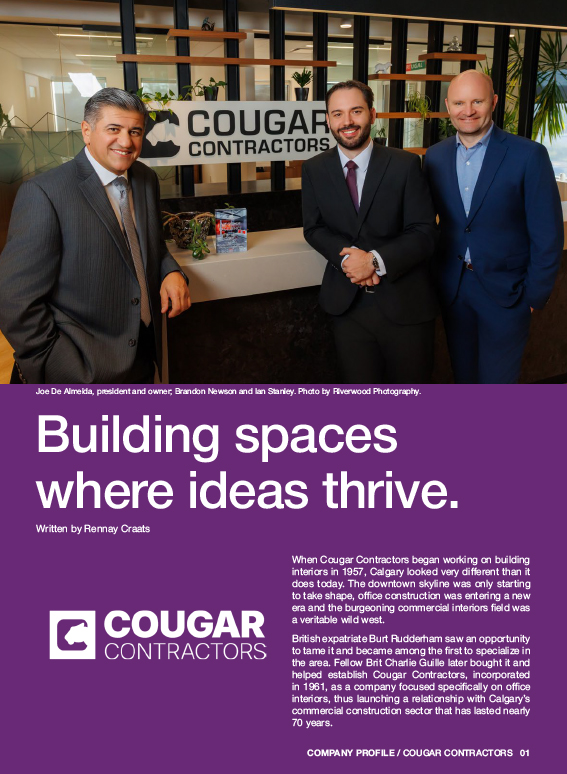
When Cougar Contractors began working on building interiors in 1957, Calgary looked very different than it does today. The downtown skyline was only starting to take shape, office construction was entering a new era and the burgeoning commercial interiors field was a veritable wild west.
British expatriate Burt Rudderham saw an opportunity to tame it and became among the first to specialize in the area. Fellow Brit Charlie Guille later bought it and helped establish Cougar Contractors, incorporated in 1961, as a company focused specifically on office interiors, thus launching a relationship with Calgary’s commercial construction sector that has lasted nearly 70 years.
“Their first job was Elveden House, which is one of the older buildings downtown that, at 20 storeys, was considered a tower back then,” says Joe De Almeida, president and owner of Cougar Contractors. “That’s how the company really got its start and it just followed the growth of Calgary from when it was essentially a one-horse town with one AM radio station to where it is today.”
Since then, Cougar has worked on more than 100 million square feet of office interiors, managing projects from concept to completion. Its stellar reputation is reflected in the company’s repeat business, with a docket filled by referrals and word of mouth rather than traditional advertising or tenders. The company has continued to grow as it navigated Calgary’s economic cycles, changing workplaces and dramatic advances in technology, all while maintaining its focus on quality workmanship, cost-effective construction and client service.
Today, Cougar employs about 22 people who manage a network of more than 100 subcontractors with up to 400 workers involved in projects at any time. De Almeida credits the incredible people, past and present, for the success and longevity of the company, and believes the positive culture accounts for its list of long-tenured employees. They meet challenges head on and have evolved with the changing market as a team, with the most recent evolution being a shift toward a more specialized project management model.
“We used to have a lot of in-house contractors, but ever since COVID, we’ve really become this niche project management company that does construction and does service, but most of the workforce that’s under us now is subcontracted out. I’d say we’re more of a project management company than we are a true construction company now,” he says.
That subcontractor network is built on more than just technical expertise. Cougar looks for subcontractors that are experienced and aligned with its values, returning regularly to a core group of trusted electrical, mechanical and specialty trades. This model allows Cougar to scale its project teams while maintaining the consistency clients have come to expect.
The pandemic accelerated a shift toward hybrid work, reducing the amount of conventional office space many companies require while changing what they want from those spaces they retain. Workstations and private offices are being complemented by collaboration areas, amenity spaces and features designed around employee experience.
This experience varies. Cougar has built yoga and fitness areas, golf simulators, pickleball and basketball courts, nursing rooms, multi-faith spaces and even medical clinics within the office. Some clients have even incorporated professional cappuccino bars or created large kitchens capable of accommodating outside chefs and catering.
“Our clients understand that these people are spending as much time at work as they are at home so it’s not enough to just put a new plant in the corner and call it a day,” he says.
For Cougar, that means an office renovation is no longer simply about adding walls, flooring and furniture. It’s about understanding how clients intend to use their space and creating an environment that supports the way people work. Companies are putting more thought into the quality and experience of spaces rather than sheer size. Natural light has become particularly important, with designers treating windows as shared resources rather than reserving the best views for corner offices.
Meanwhile, Calgary’s business landscape continues to change. More software and international companies are establishing offices in the city while consolidation, especially within the energy sector, has reduced the amount of office space some established companies need. At the same time, companies are reconsidering where employees actually need to work.
“We’ve had clients who felt they didn’t need to be downtown so they surveyed their employees to see where they lived within the city so they could reduce commutes. They ended up moving into suburban areas where the majority of their employees lived,” De Almeida says. “We’d never seen that and now there’s been two that have done that.”
These changes are creating new opportunities for Cougar. The company is exploring more suburban office work as well as projects connected to Calgary’s growing light-industrial and warehouse sectors. While these are great opportunities, Cougar’s repeat clients keep the company busy and it already has to turn lucrative projects away. De Almeida felt they were saying ‘no’ too often, so he introduced a service division to diversify Cougar’s offerings. This group now takes on smaller projects that they previously didn’t chase because of time and manpower constraints.
“Now we have guys dedicated to do small jobs for our clients, whether new clients or existing clients, because not everybody is going to be doing a $1M project tomorrow, but they need a door fixed or they want to add a window. And those were always back-of-the shelf projects that now we’ve made a specific focus to address, especially for regular clients,” he says.
This division gives Cougar another way to serve clients throughout the life of their buildings, whether they need a major renovation or a smaller repair or improvement. Cougar can also become involved before construction begins, helping assemble the required professionals to turn a concept into a buildable project or joining the client’s design team to ensure the project runs smoothly. Either way, the result is a flexible approach that can encompass project and construction management, interior design partnership, construction supervision and sustainable development. Throughout the process, Cougar lives up to its reputation for delivering quality with safety, budget, aesthetics and functionality top of mind.
This reputation was hard-earned and is fiercely protected both for the continued success of the company and to honour those who came before to build it. Joe De Almeida joined Cougar in 1999 and became the third owner after buying the company in 2013. He is honoured to be part of growing the business and is focused on ensuring the business remains strong long after he’s gone.
There are already employees interested in being part of the succession plan and De Almeida sees his role as that of a steward, preserving the values that carried the company through nearly seven decades until the next generation eventually takes over.
“I look at it like I’m a legacy position. I’m just here to carry this thing forward until the next person buys it. And the person that buys is going to be somebody who has the same values and same integrity that I was taught when I first started here,” he says. “Nothing would give me more pleasure than to see the legacy grow.”
For a company that began by helping shape some of Calgary’s earliest modern office spaces, the next chapter will be about adapting those skills to a very different commercial landscape. Whether the project is a major corporate headquarters, a suburban office, a light-industrial facility or a small service call, Cougar Contractors’ business remains rooted in understanding what clients need and finding a way to build it well.