


It’s said that “a journey of a thousand miles begins with a single step,” and International Orthotic Labs is dedicated to making sure every step is a comfortable one. Established in 2001, the company manufactures premium, medical-grade orthotic insoles that serve to correct biomechanical misalignment, relieve pain and support sensitive feet.
Over the past quarter century, the process of manufacturing custom orthotics has evolved beyond the traditional methods which involved pouring plaster to create positive molds that were then ground and sculpted by hand prior to thermoforming material around them. Today, digital technology and automation have replaced much of that painstaking work while also improving precision for a better fit.
“Many of the middle and later stages of the production process have not materially changed in the past 25 years. The materials, processes and the value of highly skilled technicians are recognizable from our early days,” says Steve Chamberlain, president of International Orthotic Labs (IOL). “It’s the primary stages that have evolved, from digital foot casting to specialized CAD/CAM software to milling automation. It all creates an ecosystem where we can fabricate with pinpoint accuracy at scale.”
Today, state-of-the-art CNC milling machines use modified digital scan files to carve precise positive molds out of medium-density fiberboard, which creates the unique foundation for the orthotic. Polypropylene or carbon fibre sheets are vacuum-formed and pressed to the mold, then ground, covered, finished by hand and scrutinized for quality. The entire process at IOL takes just five business days in the lab, an impressive turnaround time that leads the industry.
Speed alone, however, isn’t what defines International Orthotic Labs. The company has built its reputation on manufacturing truly custom quality devices. Chamberlain says that’s an important distinction in an industry where some manufacturers match foot impressions to existing “library” templates, which cuts cost (and corners) by eliminating the need for digital cast correction and milling.
“Many folks might be under the impression they’ve been prescribed custom orthotics, while they’re actually wearing a reverse-engineered template,” says Chamberlain. “Conversely, every one of the 600,000-plus pair of orthotics that we’ve crafted for our partners in the last 25 years has been 100 per cent unique to that patient’s foot.”
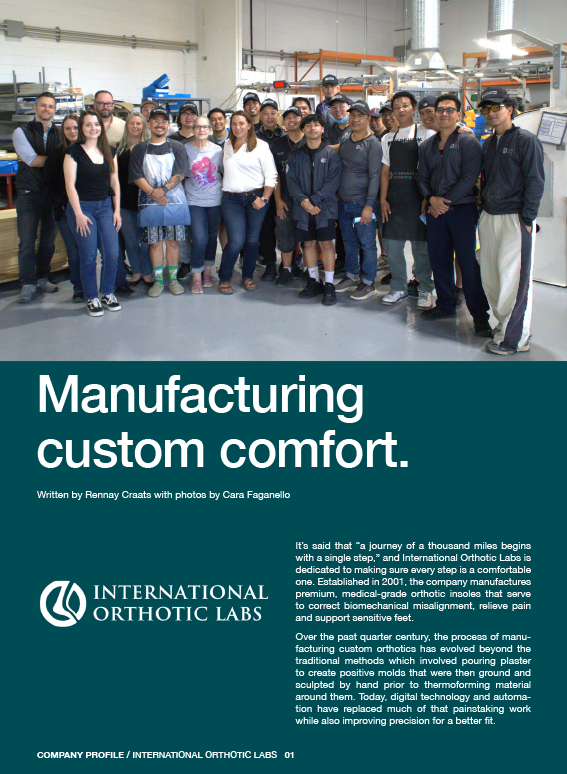
This commitment to custom positions International Orthotic Labs as a premium fabricator. Delivering that standard consistently depends on a strong team of experienced technicians and administrators, and Chamberlain says he has the best in the business. In an industry where turnover can be high, IOL has had remarkable success in team retention. Production Manager Tom Long was one of the first employees, working his way up through every aspect of the production line over 24 years. Over half the team have been with the company for more than five years, and several technicians including Suzanne Whitney, Gerry Ramos, Jayson Cruzat and Joby Encabo have been with the company for more than 10.
“It’s physically demanding work, and difficult to train for, so providing a positive culture of respect and mutual loyalty is very important to us,” says Long.
Creating an environment of pride in craftsmanship has been paramount for the ownership group since acquisition in 2021. From the start, Chamberlain and management focused on preserving the quality standards and service levels that built the company’s reputation while streamlining operations and laying the foundation for its next stage of growth.
“Transitioning a business from an original founder is always a fascinating challenge. You need a balance of people, production and partner buy-in to ensure success,” says Chamberlain. “Operationally, you need knowledge transfer to a talented group of people who are able to step into or be trained for key roles. Then the priority becomes de-risking, because you learn very quickly which processes have only a ‘the owner knows how to fix it’ backup plan. Once that’s untangled, we need to ask: ‘Is this where we should build in redundancy or is this an opportunity to design a better system altogether?’ Finally, it’s critical to effectively re-introduce yourself to your partners and clients and communicate what the transition will mean for them. What they can expect for stability, why they deserve your trust and why ultimately this will improve their outcomes, too.”
Behind every orthotic produced at the Calgary facility is a culture built around a simple acronym, GRIPS: Get Stuff Done, Respect, Integrity, Precision and Safety. Those values guide everything from workmanship and accountability to empowering employees to raise concerns and suggest improvements to respecting one another, the company’s partners and the devices themselves.
“If you’re only touching a small piece of the process when you’re fabricating at our scale, it’s easy to lose the forest for the trees,” says Nicole Tanner, Customer Success Manager. “Each component of each device is a critical building block of a patient’s health outcome and their relationship with their doctor. It’s important to remember a real person is going to rely on this device to support a majority of the 2.5 million steps they take every year.”
Far from empty words on a poster or buried in an employee handbook, GRIPS shapes how employees approach every stage of production and is a framework for strengthening relationships and reaffirming trust with partners as the company continues to grow rapidly under new leadership.
Driving growth further was a 2025 expansion into the United States, where shifting tariffs and cross-border shipping requirements created (and still create) evolving challenges. While other manufacturers shied away, IOL chose to double down on an opportunity to build a competitive moat.
It quickly became apparent that their facility couldn’t support the type of revenue and workforce expansion that IOL required. Chamberlain and Long spent over two years searching for a space that could both support future growth and provide a better environment for employees.
“We looked at a lot of different industrial spaces trying to find the right fit, but what really jumped off the page for us here was big windows with natural light. There’s not a lot of small bay industrial that can offer that,” Long says.
The company bought, retrofitted and moved into its new home last August. The bright, 6,500-square-foot production floor is equal parts workshop and high-tech laboratory where the team can manufacture several hundred custom orthotics a day during its peak seasons, with room to develop. Production remains a labour-intensive process, but the space provides potential to adopt emerging technologies – including 3D printing – once these innovations catch up to IOL’s quality standards.
The company continues to invest in its people, equipment and facilities as it expands its footprint across Canada and in the United States. In a city often defined by oil and gas, IOL is stepping out of that shadow and demonstrating that advanced manufacturing can thrive in other sectors.
“We want to be seen as a success story for manufacturing in Calgary in a non-traditional space,” Chamberlain says.
International Orthotic Labs has established itself as a leader in the market, and over the first five years of new ownership, there’s no question that the company has grown into that Calgary manufacturing success story. And that success continues to be measured one custom orthotic, and one comfortable step, at a time.