


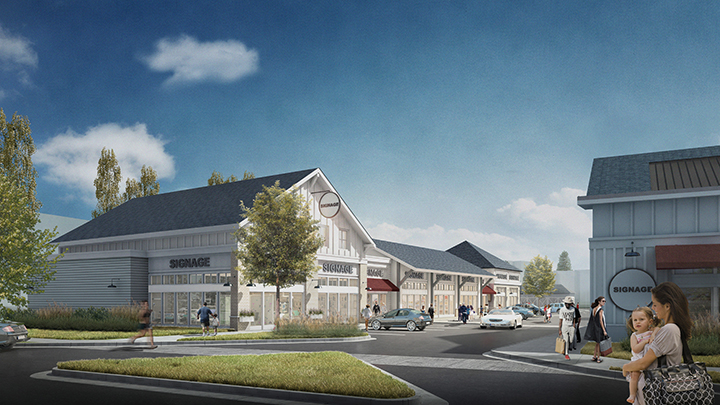
Calgary’s retail property market is running hot, with industry experts expecting demand to pressure supply through 2026.
Fueled by steady population growth, the rapid expansion of new suburban communities and a resurging downtown market, retailers are absorbing supply faster than developers can deliver it.
“We’re just not building enough to keep up with demand,” says Andrew Sherbut, partner and vice-president of retail leasing and investment sales at Barclay Street Real Estate. “Yes, we brought on a lot of new construction last year, but we are absorbing it faster than what’s coming to market.”
An end-of-year report released by Barclay found that vacancy rates have tightened in an already tight market – contracting from four to 3.7 per cent. By year’s end, available retail space remained below what the company considers a balanced market threshold of two million square feet citywide.
Sherbut traces the tight market conditions back to the pandemic when construction first stalled.
“It didn’t slow down. It came to an absolute halt. So, every year since then, it’s been catch-up,” he says. “Add to that five years of huge interprovincial migration and a post-pandemic economic turnaround, and we now have a really unbalanced situation where they can’t build enough to keep up with demand.”
As Sherbut notes, retail inventory, in fact, increased in 2025. Barclay reports that total space in the city reached approximately 45.6 million square feet in 2025, reflecting a bump of nearly 700,000 square feet since the beginning of that year.
Of note, to end 2025, new supply came from several project completions across the city. These include EV606 and The Mondrian, both mixed-use towers in the East Village, along with Junction 88 and the 10,000-square-foot Block C project in Seton. Additional deliveries include Fourth Street Lofts in the Beltline and The Podium mixed-use complex in Trinity Hills.
Yet vacancy fell in most parts of the city – including the northeast, northwest, southeast and downtown. The southwest was the only area to see a slight increase, according to the Barclay report.
“Until more development comes to the market, we will have that lack of expansion opportunity for those tenants that are looking for it,” says Sherbut.
Michal Kosmala, director of commercial real estate for Bri-Mor Developments, agrees with Sherbut, noting the supply-and-demand imbalance has been building for a few years.
Bri-Mor has a significant commercial footprint in the Calgary region, with several high-profile developments in the suburban market that include Cityscape Square and Westwinds Square in northeast Calgary, Cranston Corner and The Square in the city’s southeast, West 85th in the southwest and Yankee Valley Crossing in Airdrie.
Kosmala says the retail categories that are currently driving the most demand within Bri-Mor’s shopping centres include quick-service restaurants, medical and wellness users, convenience retail, and family-focused services such as daycares and early childhood development services.
“Over time, our mix has shifted toward service-based and experiential tenants – businesses that can’t easily move online and that serve both young families and aging residents in growing communities,” he says.
Ron Odagaki, associate vice-president of brokerage for JLL, singles out new restaurant openings as a primary reason why Calgary recently surpassed Vancouver to become the third-largest market for overall new store openings nationally.
He adds that the entertainment sector is particularly gaining momentum, “with large-format venues combining dining and activities that appeal to families and young professionals seeking experiential retail options. Medical service retail is also in demand, especially in new growth suburban communities.”
Sherbut says the new supply he’s seeing in Calgary’s retail property market is centred around service-focused and value-oriented retailers, with the strongest activity happening in Calgary’s eastern areas.
He adds the new supply continues to be dominated by smaller-format units ranging between 1,000 and 3,500 square feet. This aligns with sustained demand from service-based and neighbourhood-oriented retailers.
“Retail has changed a lot in the sense that there’s more focus on building local, self-sustaining developments,” he says. “All of these new communities, whether it be Belmont or Sage Hill or Belvedere, they all have some sort of format that includes a large grocery store anchoring different smaller retailers.”
Even when looking closer to the core, Sherbut points to a rise in the number of five-to-six storey towers in areas such as the Beltline that combine streel-level retail with residential apartments.
Maxine Morrison, executive vice-president and real estate advisor with Royal LePage Commercial, says the local market reflects a classic “retail follows rooftops” trend that’s fueled by strong population growth – especially within the city’s newer communities.
“The biggest leasing activity is happening in newer suburban communities where service-based businesses want to be near their customers,” she says.
The rub, however, is that demand for these prime locations has driven lease rates to levels that can make traditional storefronts unprofitable for some businesses. Morrison notes rents in some of these locations can go upward of $60 per square foot.
“Many of them are now having to be creative and move into adjacent office spaces or quasi-retail industrial spaces that can handle both customer-facing areas and operations under one roof,” says Morrison.
“Food places like bakeries will have their manufacturing and storage in the back, and then their counters at the front. It’s a smart, strategic way to stay competitive when prime retail spaces are just out of reach.”
Looking ahead, Odagaki expects strong demand for quick-service restaurants, casual dining and ethnic cuisines – particularly Asian and Mexican concepts.
“These operators are targeting high-traffic urban and suburban locations to capture the diverse tastes of students, families and new residents who are reshaping Calgary’s culinary landscape,” he says.
Sherbut, meanwhile, is optimistic about downtown Calgary’s retail scene, noting that back-to-work mandates have restored daytime traffic to main office corridors such as Bankers Hall.
However, he believes the true turning point for downtown will be residential growth, including office-to-residential conversion projects that will help absorb the vacant retail space that’s left in the West End and Beltline.
“They’re adding all of this new residential and we have so much vacant retail space. So, I think that’ll be the next to get absorbed,” says Sherbut.
Morrison believes Calgary’s retail property market will continue to be strong through 2026 and beyond – primarily because Calgary still continues to be affordable for retailers when compared to cities such as Toronto, Montreal and Vancouver.
“I’m still seeing a lot of people from major city centres still wanting to expand their businesses out west, and Calgary seems to be one of those major hubs,” she says. “Our inland ports – how well established it is and our positioning to the U.S. and B.C. – really gives retailers more control over their supply chains.”
At Bri-Mor, Kosmala says the company will continue to concentrate on high-growth corridors with long-term economic stability. He notes that when evaluating new retail development opportunities, the company remains focused on fundamentals such as population growth and household formation.
“If the density and spending power are there, retailers can justify today’s rents,” he says. “After that, we look closely at access, visibility, traffic patterns and co-tenancy. Pre-leasing with a strong anchor is usually what gives everyone confidence to proceed.”