


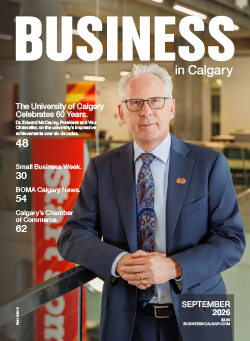
Since opening in 1966, the University of Calgary has emerged as this city’s foremost institution for higher learning, teaching, researching and creating. It is where 235,000 alumni – 120,000 of whom live in Calgary today – gained knowledge in science, engineering, law, business and many other disciplines. It is where minds have expanded, ideas have been born and the future has been discovered.
Now 60 years old (very young by university standards), the University of Calgary has achieved impressive heights in a relatively short amount of time: top five Canadian university in sponsored research revenue (approximately $632 million); top one per cent of global universities; home to more start-ups than any university in Canada over the last six years; and a 95 per cent graduate employment rate.
“We are the University of Calgary,” confirms Dr. Edward McCauley, president and vice chancellor of the University since 2019. “But I like to say we are the university for Calgary. We provide about $23 billion annually in economic impact. We’re the third largest employer in the city. And the people that we employ are creating new knowledge that drives the future of Calgary, whether in terms of talented students graduating or ideas being produced.”
Originally from Ottawa, McCauley gained a B.Sc. in Biological Sciences (1976) and a M.Sc. in Ecology (1978), both from the University of Ottawa. He earned a Ph.D. (Ecology) in 1983 at McGill University. After a postdoctoral fellowship at the University of California, Santa Barbara (1983-85) he landed at the University of Calgary in 1985 as a professor in Biological Sciences.
In 2008 he returned to the University of California, Santa Barbara, to lead a US National Science Foundation Institute. He returned to the University of Calgary in 2011 as vice-president (Research), and then became president and vice chancellor in 2019.
The university’s trajectory, a model universities from around the world now try to emulate, has not occurred by accident. Rather, some principal factors have been essential, particularly in the past 20 or so years.
A Research-Intensive University
First, is the focus on research.
“The University of Calgary has very strong faculties like law, science, engineering, medicine – I won’t name them all – which means we have incredible disciplinary excellence,” McCauley explains. “We’ve been able to combine that expertise from across all of the different faculties to tackle some really important problems that society faces, not just here in Calgary and Alberta and Canada, but around the world.”
Starting in the 2000s, this research potential became a priority. Particularly in the areas of science, engineering and medicine, the university started to self-organize around particular areas. For example, the Faculty of Medicine (now the Cumming School of Medicine) recognized the need for medical institutes for focused research.
This gave rise to the Hotchkiss Brain Institute, the Snyder Institute and the McCaig Institute, among others. “This concentration of talent in a particular area led the university to become more competitive on the national stage for external grants,” McCauley says. “That success fueled the decision in the early 2010s to identify as a research-intensive university.”
Strategic research themes were identified in order to direct transdisciplinary areas of research. “These research themes were not chosen willy-nilly,” McCauley notes. “They were chosen from the bottom up based on where we had excellence or ‘street cred’ in areas we could have the most impact.”
They were also determined based on a recognition of some of the problems society faces. “It’s really one of our superpowers,” McCauley says proudly. “And other universities are now recognizing that we’re doing transdisciplinary scholarship to work on problems that are incredibly relevant for society, and in areas that drive the economy and quality of life in Alberta.”
For example, brain and mental health is a research priority at the University of Calgary. “We brought together over 300 scholars from across different faculties to contribute to advancing that area,” McCauley explains. “Not only in terms of novel discoveries in a particular area, but how people can work together across disciplines to drive brain and mental health forward.”
The revolutionary Calgary Stroke Protocol – which grew out of a clinical trial called ESCAPE that was stopped because it was so effective – has saved lives around the world, including here in Calgary, and transformed the way stroke is treated.
“There are new aspects to it now too,” McCauley hints. “So just wait, because there are going to be to be new discoveries and innovations led by the University of Calgary.”
Other sectors include healthcare (imaging, immunology, cancer treatment), energy (extracting resources while minimizing the carbon impact they have), agriculture (the Faculty of Veterinary Medicine has doubled in size over the last two years), and deep tech and computing (Calgary has the fastest growing tech sector in Canada).
Quantum technology is another important area. “We have chosen to activate Calgary as a quantum city,” he explains. “Quantum technology will be the next wave and is expected to surpass AI in terms of impact around the world. If we can harness the power of understanding quantum mechanics, it will really change things.”
The university has established Quantum City on campus, which has attracted new scholars, investment and venture capital. “We are investing significantly in quantum cybersecurity,” McCauley continues. “In essence we’re laying the building blocks of the new worldwide web that is quantum based. It’s about being ahead of tomorrow.”
Near earth space technologies are another important area for Alberta and Canada, and one the University of Calgary leads in. “We receive more money from the Canadian Space Agency than any university in the country,” he says. “We focus on satellite, geospatial, and understanding the environment between earth and space in such a way to design communication and sensing technology systems.”
These advancements provide incredible advantages in other areas like agriculture, automotive, remote medicine and the miniaturization of medical devices for use in space.
“When NASA is determining with whom to collaborate on going to Mars, the University of Calgary is first on speed dial,” McCauley says proudly.
Last year, the university received $632 million in external research revenue – funds won through competition – 70 per cent of which goes into jobs right here in Calgary.
A positive feedback loop results: the more competitive awards and grants the university receives, the more access to major programs it has. This includes the Canada Research Chair program: “We’ve almost doubled the number of Canada Research Chairs we have at the University of Calgary because of the success of our scholars.
In 2023, the university was awarded the largest grant in its history: a $125-million grant from the Government of Canada, through the Canada First Research Excellence Fund, for child health and wellness. This helped to launch the One Child Every Child (OCEC) initiative, which focuses on three key themes – Better Beginnings, Precision Health and Wellness, and Vulnerable to Thriving.
“OCEC is an excellent example of local community partnerships utilizes global partnerships to build comprehensive data and technology to create impactful evidence for child health outcomes,” McCauley says.
An Entrepreneurial University
The second principal factor essential to the university’s trajectory is the focus on entrepreneurship.
“Entrepreneurial thinking is about recognizing opportunities,” McCauley explains. “We live in Canada’s most enterprising city and we are Canada’s entrepreneurial university. We encourage our undergraduates, graduate students, faculty members and staff members to take risks. Look at the world around you, see the opportunities and be bold about thinking about what solutions you might offer, either alone or with your colleagues. Don’t be afraid to make mistakes. Let’s start something.”
It was in the early 2010s that the notion of UCalgary as an entrepreneurial university coalesced across the entire university. “A lot this was driven by our Calgary community, both in industry and other areas, recognizing that the University of Calgary could have a big impact, but needed help,” McCauley notes.
Philanthropic donations have been key: the Hunter Hub for Entrepreneurial Thinking was established in 2017 with a very generous gift from the Hunter Family.
“It is the first stop for someone starting out on the journey of entrepreneurial thinking,” McCauley explains. “Where they can get the right support and mentorship to make things happen. And by doing it at the institutional level rather than by faculty, we were able to accelerate it significantly.”
“And when you combine that with being able to collaborate across fields, it really does differentiate the University of Calgary in its first 60 years,” he continues.
That differentiation is evidenced by the fact that the University of Calgary is the number one university in Canada over the last six years in terms of new company creation.
A Focus on Students and Faculty
With roughly 38,000 students per year, one of the goals of the university is to ensure these young minds have the best possible experience. Today’s campus is vibrant, particularly since the development of University District just west of campus.
“We have almost 7,000 students starting in September and our goal is to is to get them to understand the power of being a University of Calgary student as quickly as possible,” he says. “Not just their scholarly path, but how they can build their networks, seize opportunities and start something for themselves.”
As a result of these efforts, the University of Calgary is top five in terms of student engagement in the country. This is a measure of critical thinking skills like reasoning, communication and analysis – crucial for employers and one of the reasons that 95 per cent of undergraduates get jobs within six months of graduation.
A majority of undergraduate students come from Alberta. At the graduate level, roughly 35 per cent are international. “And that’s a great thing because those students have been trained in some of the best places in the world, and are choosing to come to the University of Calgary to pursue research with our scholars here,” McCauley points out.
So too are top scholars choosing the University of Calgary. “Capital, including talent, follows excellence and excellence will go to wherever the best opportunities are,” McCauley explains. “We are a very popular destination for faculty because we’ve identified areas of excellence where people can really develop their career.”
Another attraction for scholars from around the world is the larger Calgary community: “Calgary is such a special place because we are a young, dynamic city with a high quality of life. It’s a great place for families.”
With so much going for it, the University of Calgary has more people who want in than it has room for. For every four qualified students that apply, only one can be admitted.
“We’re working hard on that challenge,” McCauley explains. “Thinking about ways to modify our curriculum and take advantage of new tools. We’re working hand-in-hand with the Ministry of Advanced Education to ensure we are expanding our seats and admissions.”
“We’re expanding rural health programs, for example, including nursing and a partnership with hotel University of Lethbridge for medical seats,” he adds.
Looking Forward
While the 60th anniversary is cause for much celebration, the University of Calgary, led by McCauley, is not resting on its laurels.
“A lot of things are being copied by other institutions,” he concludes. “But our executive leadership team is really focused on the next 10 years. So we’re not standing still. We’ll continue to be entrepreneurial to fulfill our mission.”