


There’s a fine line between a boom and a surge.
For Calgary construction, the boom/surge is momentum and exciting news. Stats and trends show that last year was good for Calgary construction, and this year will likely be even better!
Momentum and more good news for Calgary’s builders, developers and construction workers.
Good news for Calgary housing starts (residential, multi-family), commercial and industrial, a long list of scheduled infrastructure, good news for thousands of Calgary construction jobs and a good news infusion into City coffers.
The Calgary boom/surge, which spiked in the second half of last year, continues to be driven by rapid population growth. According to stats, in the past five years, Calgary’s population swelled by more than 250,000 people, an increase unmatched in Calgary’s history.
It continues exciting growth for the city, sparking high housing demand, with major increases in both single-family and multi-unit housing starts, and major commercial and apartment complexes and infrastructure projects.
Calgary’s construction sector was already busy with a 2025 jump in housing starts, actually outpacing other Canadian cities like Vancouver and Toronto. And the boom/surge continues.
Although it is relatively early into 2026, there is already a strong Calgary push for higher density, with large apartment buildings, especially in core and growing suburban areas, purpose-built rentals and diverse infrastructure including like roads, overpasses, off ramps, schools and commercial developments.
“Housing starts in the Calgary Metropolitan Region have hit record levels for the fourth consecutive year,” says the upbeat Brian Hahn, CEO of BILD Calgary Region. “In addition to our region’s natural beauty and ample opportunities for recreation, one of the most attractive things that draws both international and interprovincial migration to the region is a strong employment market.
“Construction is booming because housing supply is the key to unlocking affordability. And BILD members’ response to the strong migration of Canadians, and new Canadians, to the region has been key to Calgary maintaining a position of strong affordability.
“Government policies with respect to migration and the regulatory paradigm for land development, redevelopment and housing are key factors influencing both this year’s demand and the timely supply of housing, while another boost is this year’s promised zero GST for first-time homebuyers on new home purchases.”
The housing start boom/surge is good news for Calgary growth, and opportunities for Calgary builders, developers and jobs for Calgary trades and construction workers.
While a lingering skilled trades crunch continues to be a challenge for Calgary construction, Mike Martens, president of the Independent Contractors and Businesses Association (ICBA Alberta) – the respected voice of the open shop construction industry, and the largest construction association in the country – shares the positivity that, “The vast majority of our members are busy. Last year, the construction industry as a whole saw gains of over 8,900 workers year-over-year.
“Despite the Calgary construction surge,” he notes, “the biggest pressing issue is the lack of experienced trades workers, project managers, estimators, etc. The residential sector calls it ‘the missing middle,’ referring to skilled trades. And it will likely continue to be a problem for several years.
“Labour supply for skilled trades continues to be key across all stages of residential and commercial construction,” Hahn points out. “Particularly accredited roles such as electricians, plumbers and HVAC technicians, as well as other skilled positions such as framers, drywall installers and finishing carpenters.
“BILD members are also acutely aware of demographic factors which require continual replenishment of this important labour supply as today’s labour supply inevitably moves into more responsible positions and ultimately onto retirement. This phenomenon impacts all the skills necessary for robust housing supply.”
BILD continues to work with industry partners, including the Calgary Board of Education, the Calgary Catholic School District and Southern Alberta Institute of Technology (SAIT) as well as The City of Calgary and the Government of Alberta to promote careers in the trades and construction.
Despite the exciting construction momentum and opportunities, Calgary construction professionals caution that productivity and cost control may continue to plague the industry across all sectors. While tariffs and inflation are partly to blame, the construction sector urges that not enough is being done to reduce project approve times and reduce policies and regulations that slow the time to build projects.
Martens admits that some speedbumps from last year continue for Calgary’s construction sector. “While greenfield industrial projects were at a relatively low level, many industrial contractors maintained their level of work through diversification by expanding their services into maintenance or even the commercial or institutional spaces.
“But no doubt about it. Both the multi-family high-rise and single-family residential sector in Calgary was explosive. The volume of units produced was an all-time high.”
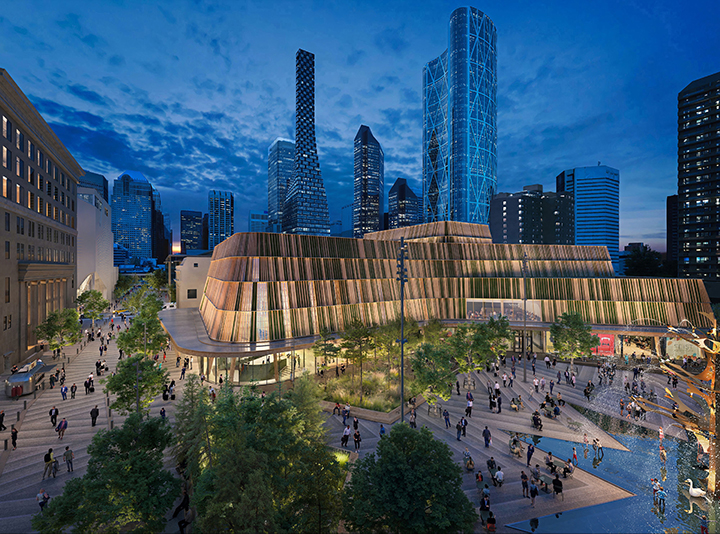
The dynamic Calgary Municipal Land Corporation (CMLC) continues in overdrive as a Calgary construction game changer. Last year, the completion of The Open, the innovative community amenity in East Village, attracted 35,000 visitors in its first 10 months, a 97 per cent positive rating through facility surveys and earned the Canadian Architect Award of Merit.
“Calgary’s economy in 2026 will continue driving momentum,” says CMLC president and CEO, Kate Thompson. “The expanded BMO Centre is attracting more conventions and events, spurring significant hotel investment that will be supported by infrastructure improvements. And we’re delivering in The Culture + Entertainment District.
“Calgary’s rapid population growth underscores the need for ongoing investment in housing, infrastructure and amenities. Projects like the Werklund Centre and Olympic Plaza Transformations. In East Village, CMLC’s developer partners are advancing five residential mixed-use residential developments through regulatory approvals with anticipated construction starts this year.
While residential and commercial development are usually the focus of Calgary construction, the pace of Calgary construction very much includes the many infrastructure projects on the schedule for 2026.
According to Josh Hesslein with the City’s Infrastructure Services, “While the economy has overall been affected by a range of factors over the past several years, there is an important need to repair, maintain, upgrade and develop new infrastructure to ensure Calgary is a place where people can live, work and play.”
The City completed a number of construction projects in 2025, including the Eau Claire Plaza Redesign, a vibrant, all-season public space; The Marda Loop Main Street project reimagined the streetscape and revitalized 11 blocks along 33 Avenue and 34 Avenue SW; the Calgary Soccer Centre (CSC) Dome; the Mission Bridge rehabilitation project; and more.
With Calgary’s construction boom/surge, 2026 is already busy for infrastructure.
Council approved the 2026 budget, lowering the property tax increase to 1.6 per cent and committing $3.8 billion in capital spending, with $201 million allocated towards infrastructure, such as:
- 14 Avenue and 14 Street NW Bridge rehabilitation
- Symons Valley Centre redevelopment and Munro Park upgrades
- Bridgeland Main Street and Stephen Avenue revitalization
- the Rocky Ridge Athletic Park addition of two outdoor multi-use sports fields and supporting amenities in Calgary’s northeast
- Country Hills Blvd widening of 36 Street to Barlow Trail NE
Not to mention the usually busy Calgary schedule of orange cones, snarled traffic and paving and other roadwork detours.
ICBA Alberta’s Mike Martens explains that, while the volume of civil (road) work across the province had been decreasing between for about four years, 2025 saw an improvement with government commitments to more stable consistent funding.
“A key signal was the moving forward of the QE2 improvements in Calgary. It’s a project that was delayed for years, but is finally getting built. Construction on the Greenline finally got underway and is not reaching full speed until this year.”