


Calgary’s downtown office space has been historic. For four decades, Calgary’s downtown office space was the raved about, high profile star of the Calgary commercial real estate show.
The initial boom, from the ’70s to the ’90s, was triggered by the OPEC oil crisis when global energy investment suddenly flooded into Alberta. Calgary was transformed from a mid-sized prairie town into the energy capital of Canada, needing lots and lots of downtown office space.
The second surge happened from 2000 to 2014, as massive capital investment into Alberta’s oil sands sparked another downtown commercial real estate boom, with major developments like The Bow and Brookfield Place.
Then Calgary’s commercial real estate situation slumped, even before COVID lockdowns, and shrunk workplaces.
The late-2014 oil market collapse triggered a massive downturn in energy employment; millions of square feet of premium Calgary downtown office space flooded the market and the downtown vacancy rate climbed to over 30 per cent.
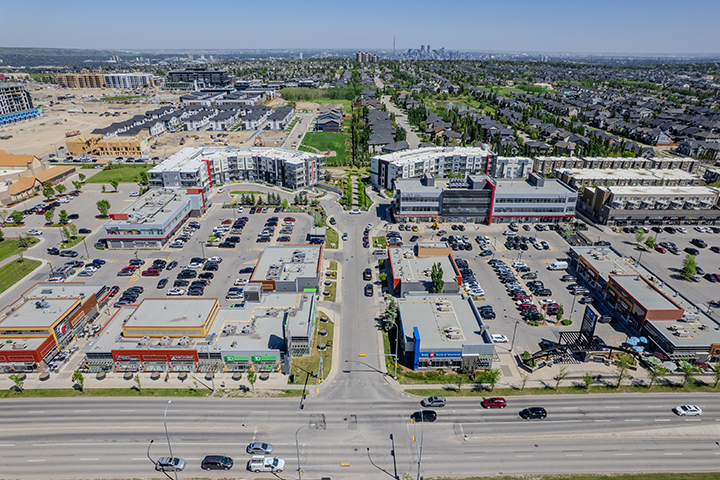
Meanwhile, suburban commercial real estate is surging.
For various reasons, Calgary’s suburban commercial space – office, industrial and retail – is suddenly hot and getting hotter.
“Absolutely, there has been a clear and sustained shift toward suburban commercial leasing over the past two years,” says the plugged-in Michael Hoffman, vice president and managing director of CBRE in Calgary. “While downtown office leasing still captures headline transactions, suburban and neighborhood commercial centres have quietly outperformed on consistency and tenant demand.”
He tracks market data showing the suburban office market’s positive or stable absorption through much of 2024-2026, while downtown vacancy remains materially higher. In Q1 of this year, suburban vacancy sat near 17 per cent, compared with the recent downtown vacancy above 29.9 per cent.
“It is the largest gap ever recorded between the two markets in Calgary and has reinforced the trend toward leasing outside the core, particularly for smaller to mid-sized tenants and service-oriented businesses.”
According to Brennan Yadlowski, principal and managing director with Avison Young, Calgary, “There has been a notable spike in commercial leasing outside of the city limits within satellite communities such as Cochrane, Airdrie, Okotoks, Chestermere, High River, Foothills County and Rocky View County.
“Over the past five years, leasing volume has experienced an approximately three-fold increase compared to the five-year pre-pandemic baseline. Based on annual square footage leased, retail activity has averaged 57,000 square feet per year over the past five years, peaking dramatically in 2023 at approximately 77,000 square feet.”
Today, in the suburban commercial real estate category, retail leasing is experiencing strong demand.
“Retail leasing in areas outside the inner-city core has traditionally been a major source of activity in Calgary, due to the creation of new communities and their associated retail centers, compared with infill development in established communities,” notes Michal Kosmala, director of commercial real estate with Bri-mor Developments, the respected Calgary company focusing on residential and commercial real estate development.
Bri-mor’s portfolio predominantly consists of suburban retail plazas near multi family rental development. Some key properties include Cityscape Square, and the mixed-use West 85th with two apartments behind the retail and office components.
“Suburban retail is a vital source of leasing activity because new communities create demand for grocery, food and beverage, medical, personal service, childcare, fitness and other daily-needs retail. The suburban trends also show an ongoing shift towards value oriented, discount grocery and retail options.
“Retail centres have a continued shift towards more personal service, experiential and lifestyle retail, and food and beverage options,” he says.
“It is a trend in most Calgary suburban areas. Recent vacancy rates range from 2.4 per cent in the SE, 2.5 per cent in the NE, and 3.6 per cent in the NW.”
The experts suggest that retail in suburban communities typically benefits from the strong evening and weekend after work hours activity.
Commercial real estate facts and figures underscore that, while many organizations implemented return-to-office policies in the past two years, actual daily office utilization has plateaued below pre-pandemic levels, reinforcing Calgary demand for smaller, more efficient suburban footprints rather than large downtown offices.
Another Calgary suburban commercial edge is that outside-the-city locations are better aligned with hybrid work models, shorter commutes and employee convenience, especially for firms prioritizing retention.
The strong return to office trend may also be shifting some daytime spending back toward downtown, but personal and medical services that are driven by appointments are unlikely to be affected by a return to the office.
Overall, hybrid work may have helped suburban retail, but population growth, limited supply and convenience-driven shopping are the larger drivers.
Bri-mor’s Kosmala adds that outdoor retail plazas anchored by grocery stores continue to draw the greatest demand, because the dependable and strong draw of a grocery store ensures that the remaining tenants within the plaza can rely on a higher level of repeat traffic and sales.
The details and market factors are different, making the comparison between downtown and suburban commercial real estate a bit of an apples/oranges situation.
Recent numbers show that suburban is undeniably outperforming downtown, and Calgary’s vacancy gap between suburban and downtown office space is at a record high.
Suburban Class B inventory is experiencing heavy positive net absorption, driven by industries like construction, education and social services. Industrial and retail demand is booming.
Hoffman explains, “Suburban properties have been the beneficiaries of Calgary’s population growth as they have been more suitable for uses that may not align with downtown high-rise office space, like education, social services, childcare and service based or quasi-retail uses.
“In parallel to these sectors that are catching up to population growth, demand for additional office space has come from EPFC (Engineering, Procurement, Fabrication and Construction). On the supply side, there have been minimal shocks from sublease or new construction that have impacted vacancy.”
The differences also show up in the leasing facts and figures.
Kosmala differentiates that stronger suburban demand over downtown retail is reflected in the large discrepancy in vacancies.
Suburban retail vacancy ranges from a low two to three per cent, while beltline and downtown vacancy rates are 10.1 and 8.4 per cent. “Some reasons for the large difference are the ongoing high vacancy in beltline and downtown office spaces, availability of new, higher quality space, tenant considerations around convenience, parking, access, safety perceptions and changing downtown commuter patterns,” he says.
Yadlowski points out new tenant trends with suburban space tenants. “Demand for office is medical and dental, private education and professional services (engineering, law, accounting, wealth management). For retail, it’s quick-service restaurants, grocery, pharmacy, healthcare and wellness. All the types of essential businesses that come with a growing population.”
While downtown commercial space still boasts the drawing powers of prime downtown location, prestige, C-Train access and other classic downtown features, suburban space tenant priorities are different and more practical, particularly for small and mid-sized occupiers.
Convenient parking (often at no cost). Ease of access for employees and customers travelling from other parts of Calgary. Grocery or essential-service anchors for retail centres. Modern or flexible floorplates suitable for hybrid operations. Proximity to residential growth areas. Amenitized buildings or walkable neighbourhoods with amenities nearby.
It’s inevitable but the strong demand for suburban commercial space is impacting rates and lease terms. “The low vacancy rates in existing product and limited new development continues to push rates higher with reported rental growth of approximately 2.1 per cent, year over year in 2025,” Michal Kosmala explains. “Net rental rates vary largely based on the format of the space, location and age of the space.”
Suburban open-air plazas range from $30.00 psf to $50.00 psf; $35.00 psf to $70.00 psf for power centres; and between $80.00 psf and $150.00 psf for regional enclosed malls.
For the balance of the year and into 2027 – with factors like BTO, re-imagined space layout and new amenities – will Calgary’s commercial office real estate pendulum swing?
Time will tell.