


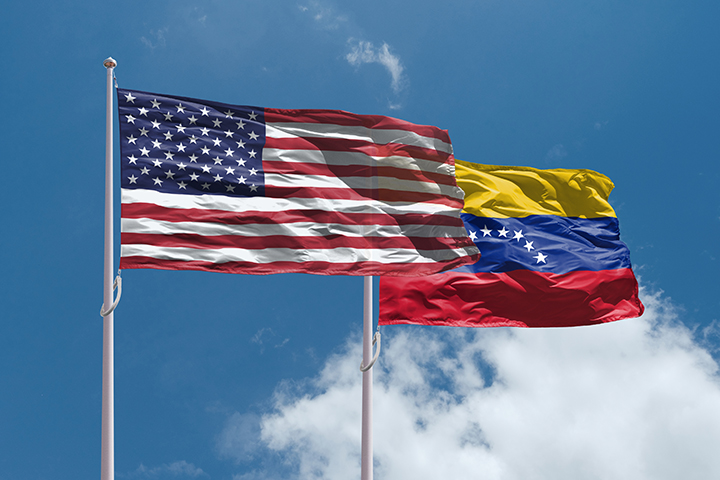
Some shrug that it’s just more, hollow, Trumpism bravado.
Of course, the formal, businesslike and diplomatic response to the recently announced American-Venezuelan oil deal – giving the U.S. control of 20 per cent of Venezuela’s oil reserves – is measured and complex but, by all indications and oil industry reactions, Aberta and Canada are not overly worried.
The globally respected Canadian Association of Petroleum Producers (CAPP) is following the news closely and taking it very seriously. “The U.S. is the world’s largest oil producing nation and they have just gained increased access and control over one of the largest known oil reserves on the planet,” explains Lisa Baiton, CAPP president and CEO. “While there is uncertainty around how fast Venezuela can grow its oil exports, we should not underestimate the speed at which the United States can attract and deploy capital into the region.”
So far, no terms of any agreement have been released but industry analysts caution that, if past is prologue, it’s impossible to sift facts from Trump bluster.
Apparently, the deal involves the U.S. government and an unnamed private operator in Venezuela forming a new private company with 100-year rights to Venezuela’s untapped oil fields, allowing the U.S. to control more than 65 billion barrels of Venezuelan oil.
There’s Canadian and global industry consensus that, at best, the deal is shaky and fraught with oil industry technicalities.
Mostly because the thick, tar-like Venezuelan oil requires specialized refineries to process and there are also major infrastructure issues, specifically, a lack of infrastructure to extract the oil, after years of under-investment and deterioration.
Repairing pipelines, power systems, drilling equipment and upgrades could take years and billions.
“In theory, the deal may be financially viable, but it’s operationally challenging,” explains the plugged-in Marc Ercolao, economist at TD Economics. “Venezuela has long held some of the largest proven oil reserves yet only produces around 1.1 million/bpd. Reserves are not the issue, but rather the years of underinvestment, infrastructure and sanctions that have left their oil industry in a lagging position. Even if Venezuela can attract enough capital, we’re looking at a five-to-10-year runway before any material and sustained growth in production occurs.”
Industry experts and analysts also point out that, deal or no deal, Venezuela’s indefinite and ongoing political instability could sink any ambition to rejuvenate the country’s oilpatch. The forecasts predict that, if Venezuela’s oil industry does rebound, by that time, both the U.S. and Venezuela will have different leaders and new governments.
“There is significant political risk in Venezuela and, in various ways, the Trump deal exacerbates rather than alleviates it,” notes Dr. Heather Exner-Pirot, senior fellow and director of Natural Resources, Energy and Environment at the distinguished Macdonald-Laurier Institute. “It means the big money, the tens of billions of dollars needed to increase Venezuelan production over a decade by a million or more barrels, will likely be on hold.”
The experts agree about the differences between Calgary crude and Venezuela crude play a significant role in the U.S. becoming competition for Alberta.
“We have a similar quality of crude. About 10 per cent of the world’s oil market is heavy oil and Canada and Venezuela, alongside Mexico and Iraq, are top producers,” she explains. “Many of the gulf coast refineries in the United States were built or adapted to accommodate heavy crude, after the original OPEC crisis. As Venezuelan production declined during the Chavista years, Canadian heavy oil increasingly filled the gap.”
Ercolao points out that in theory it is competition but not a major threat in the near-term. “There will be some competition at the margin because Venezuelan and Canadian heavy crude often target similar refinery markets. But Canada’s producers have spent years building market access and customer relationships, so I don’t see this as an immediate threat.”
He suggests the bigger question of how much Venezuelan production can actually grow is far from certain.
“Competition? Yes. Maybe,” explains RJ Johnston, director of energy and natural resources policy at UCalgary’s School of Public Policy. “Quality-wise, they are very similar gravity and sulfur content. Venezuelan oil used to have a major cost advantage but cost of capital and production in Venezuela have gone up, while it has gone down in Canada over the past decade. The scale is fairly small in the five-year outlook. The competition will be on the U.S. Gulf Coast more so than the U.S. midwest markets, which are far more important to Alberta.”
Exner-Pirot predicts that, “Venezuela will likely see some incremental oil production and it will compete with Canadian heavy oil, especially in Gulf Coast refineries. The effect is we get a lower price for our barrels, what we refer to as a differential between WCs and WTI barrels.”
One major Alberta advantage is the reality that, compared to Venezuela, the oilsands are state-of-the-art, multi billion-dollar, booming facilities already built, paid-off and continuously updated.
Regardless, the experts caution that Canada cannot be complacent!
Baiton suggests the proposed U.S. deal underscores the importance of Canada remaining a competitive destination for energy investment in an increasingly unpredictable global market. “It means adding new customers, growing production and exports, and strengthening our economic sovereignty while building greater resilience to trade volatility. Canada has significant advantages today, but it must move to capture a greater share of the global market, at a time when countries around the world are seeking our energy exports.”
Johnston also underscores the timely opportunity for western Canada. “It reinforces the importance of our efforts to move oil to Asia Pacific markets to avoid a glut of heavy oil in the USA, even if the risk of that glut is several years away at best.”
Ercolao is positive and practical, explaining that for Canada, the main risk is that more Venezuelan oil eventually does add to global supply and ultimately puts pressure on prices. “That could create some headwinds for producers, government revenues and investment in the energy sector. But given the significant work required to rebuild Venezuela’s oil industry, it is not an immediate challenge for the Canadian economy.”
He cautions that ‘the deal’ is a development worth watching closely but not one that should keep Canadian policymakers or producers up at night.
“By the time Venezuelan production meaningfully ramps up (if at all), Canada’s market exposure may look quite different, with potentially new pipelines and capacity re-routing more barrels to Asia by early-to-mid 2030s.”